
What if?
How did students get by without the internet, Google, lap tops, AI, GPS, etc. etc.? My contribution to a yearbook honoring Middlebury College’s class of 1976.

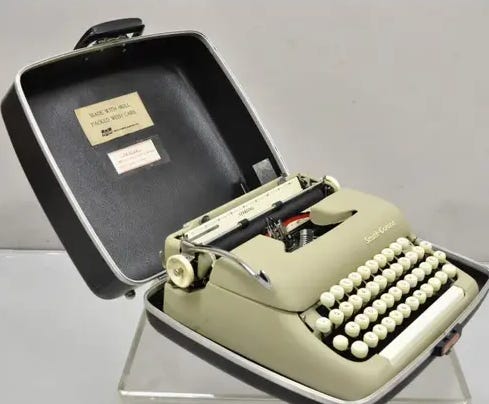
Toting a desk lamp bought with Green Stamps and my father’s portable, non-electric typewriter, I moved into Battell Hall (another relic) in 1972. Every semester, my assignments, typed on onion skin paper and blotchy with correction tape fixes, grew fainter and fainter until they were barely legible. Changing the ribbon was beyond my questionable executive function to the annoyance of many professors.
Revisiting some of those papers more than 50 years later is like coming across a trove of crumbling documents penned with quill and ink in a previous century. Come to think of it, it was a previous century! No doubt, a laptop would have made my undergraduate career easier for me—and my teachers.
In fact, Word, Gmail, Google Maps, JSTOR, Expedia, Zoom and any number of other digital tools would have considerably eased my work in and outside the classroom. But would they have made my work better?
Even today, those drawn to Middlebury’s rural setting have chosen to live in relative isolation from the teeming world beyond the Green Mountains. During our time at Middlebury, though, the campus’s solitude was compounded by the era’s technical limitations. Calls home were made on the dorm’s pay phone, letters came by snail mail, news sources were few and research often relied on microfilm and printed periodical indexes.
But, we didn’t know what we were missing and maybe that’s the point.
The Internet, with all that it has to offer, would not have improved my college work or my life, for that matter. Even in a remote setting like Middlebury’s, there’s so much that could be lost living in a digital universe awash with distractions, options and information (both real and fake). It was difficult enough for me to focus in college. Were I in college now, it might have been impossible.
With the world in my laptop, I’d effortlessly drift away into that bottomless rabbit hole that is the internet, overlooking my beautiful surroundings, fledgling friendships and the resources Middlebury provided. There would always be something else, whether illuminating or silly, competing for my attention online. It would be all too easy to forget where I was and what I was there for. Upon graduation, hours spent online would have swiped untold hours from my presence on campus.
Not only that, the internet would have threatened to atomize the student body. There would be no need to gather in front of the television in the student lounge or study together in person in the library. Instead of hilarious or heated discussions among classmates in the SDUs, I picture scores of students staring at their phones over dinner, maybe with their headphones or earbuds on. Would anyone even bother to show up for foosball in Proctor while Benny and the Jets played on the jukebox?
I’m not a Luddite in any sense of the word. After graduation and a series of assorted jobs, I eventually became a feature writer for the Baltimore Sun. Instead of typing, I became a half-decent “keyboarder.” I learned that a personal computer could help me think, organize my thoughts, make revisions and deadlines with greater ease. And there were no typewriter ribbons to change. Still, I’m grateful that my college experience was digital-free.
As an American literature major, (yet another campus relic), it’s only natural that Robert Frost comes to mind when I ponder the pros and cons of an education in this plugged-in era. Would Frost’s work have been better if he had Google Maps? Sitting in his Ripton writing cabin, he composed “The Road Not Taken,” a conundrum of a poem that leaves readers eternally puzzled by the poet’s take on choice and fate. Imagine if Frost tried to write that poem today. GPS would have told him exactly what road to take, and that, sadly, would have made all the difference.
.
This reminds me of the small non-electric typewriter that I used for my papers. And I would first hand write the text for my paper. Then once I had made all my hand written edits, I would copy the text on my typewriter for the final paper that I would hand in. Quite the laborious process. I also seem to remember giving my senior thesis to be typed by another student who made money by typing papers for others.
Great piece! I yearn for the days of onion skin paper and changing typewriter ribbons-